
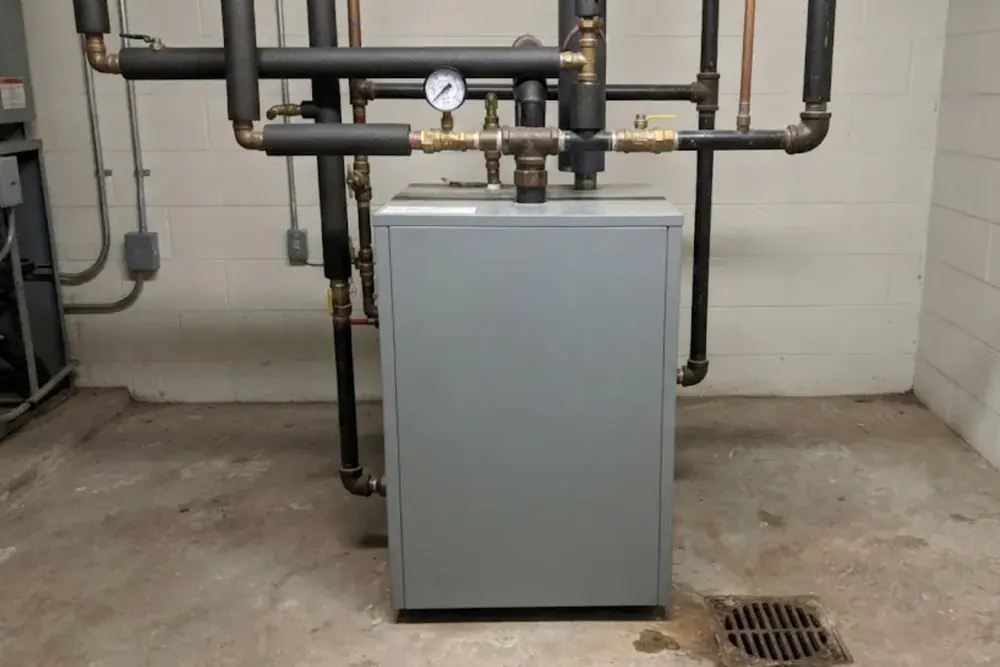
Common boiler problems
| Symptom | Likely cause | Fix |
|---|---|---|
| No heat | Failed circulator, thermostat or ignition | Test and replace the failed part |
| Banging or kettling noise | Mineral scale or trapped air | Flush and bleed the system |
| Pressure too high or low | Bad expansion tank or a leak | Check the tank and the fill valve |
| Leaking around the boiler | Failed valve, fitting or heat exchanger | Repair or replace |
| Radiator cold at the top | Air in the system | Bleed the radiator |
| Boiler shuts down | Low water cutoff or safety trip | Find the cause before resetting |
A boiler runs a closed loop, so a pressure gauge that keeps dropping means a leak somewhere. Do not keep topping up the system without finding it. If the boiler is also your hot water source, see water heater repair.
Before you call
- Check the thermostat is set to heat and has fresh batteries
- Look at the pressure gauge, which should usually read in the middle of the range
- Note any error code on the display
- Look for puddles near the boiler and along pipes
- If you smell gas, leave the house and call the gas utility or 911 first
Repair or replace
Boilers last a long time when serviced, often twenty years or more. An older cast iron boiler may be worth repairing. A boiler with a cracked heat exchanger is not. The plumber gives an honest view on age, efficiency and the cost of repeated repairs.
A new condensing boiler is more efficient but needs a drain and special venting.
Annual service
A yearly check of the burner, controls, safeties and water level catches small problems before winter. Bleeding radiators and checking the expansion tank are part of it.
How to bleed a radiator
Releasing trapped air
- Turn the heat on
Let the system run until the radiators are warm.
- Turn the heat off
Wait until the circulator stops, so you do not draw in more air.
- Open the bleed valve
Use a radiator key and turn the valve slightly, holding a cloth to catch drips.
- Close it when water appears
Hissing means air is leaving. Close the valve when water comes out in a steady stream.
- Check the boiler pressure
Top it up if it dropped, following the manual.
What a service visit covers
A yearly visit checks the burner flame, the heat exchanger, the circulators and the safety controls. The plumber tests the pressure relief valve and the low water cutoff and looks for leaks along the piping. Small problems found now are far cheaper than a failure on the coldest night.
Ask for a short written note on the boiler's condition, so you have a record to compare next year.
Work like this is judged against the Ohio Plumbing Code, the standard inspectors apply. Greene County Public Health handles plumbing permits and inspections in the county, so ask your plumber who pulls the permit and what the inspection covers before the work starts.
Heating older Fairborn homes
Some older homes in Fairborn, including those in the Historic Osborn District, may have hydronic heat with radiators from earlier decades. These systems often have old piping and valves, and parts for them can take longer to find.
Boiler work involves gas and water, and plumbing permits and inspections for the county are handled by Greene County Public Health. Rules vary by job, so ask whether a replacement needs a permit.
What changes the price of boiler repair
A boiler failure from wear is not usually an insurance claim, but resulting water damage from a sudden leak may be. Call for your real number.
The line is open 24/7 and same-day visits are offered when available. Boiler problems in winter are handled as urgent.
Usually scale or trapped air. It should be checked soon, because kettling can damage the heat exchanger.
Every year before the heating season.
Leave the house and call the gas utility or 911 before you call us.