
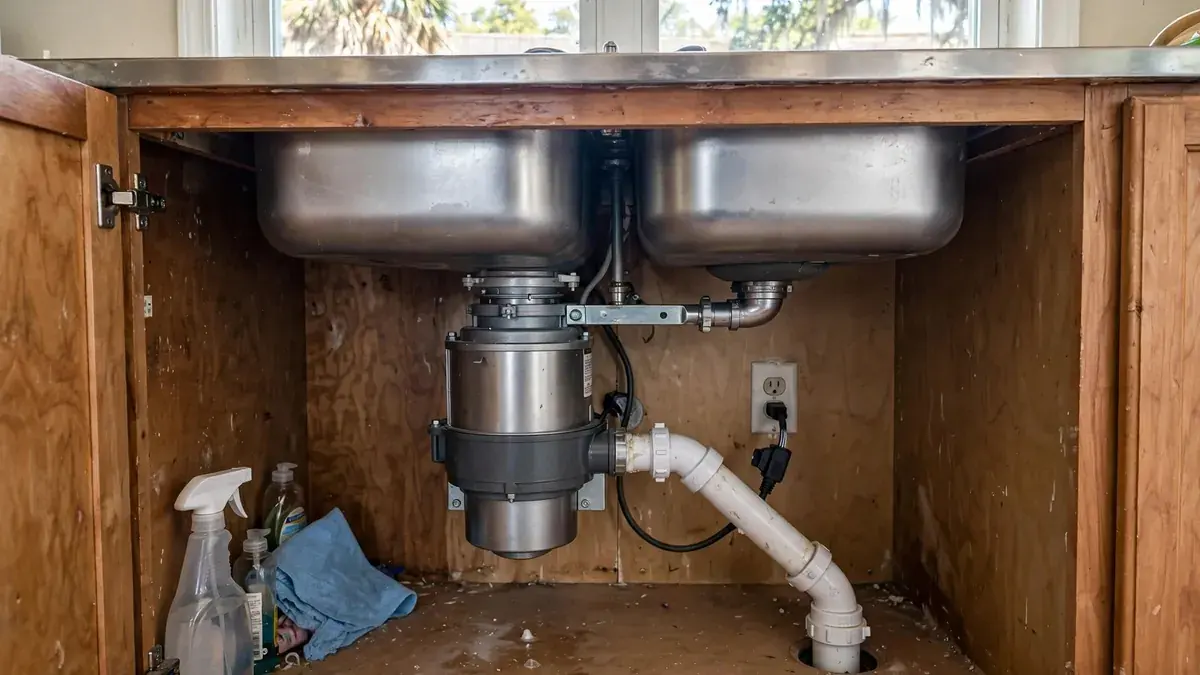
Disposal emergency: what to do right now
A jammed disposal usually hums and does not turn. A dead one makes no sound at all. A leaking one drips from the bottom, the side or the sink flange. Any of these can leave a kitchen sink unusable and water standing.
Turn off the switch and the breaker. Do not use chemical cleaners, which can spray when you or the plumber open the line. Dispatch will tell you what else to check.
Quick checks before you call
- The reset button on the bottom of the unit has not popped out
- The breaker for the kitchen is on
- The sink is not backing up into the second basin
- There is no standing water under the sink
- The leak, if any, comes from a seam or from the pipe joints
| Symptom | Usual cause | Fix |
|---|---|---|
| Hums and does not turn | Jam from a hard object or stuck flywheel | Free the flywheel, remove the object |
| No sound or movement | Tripped reset, bad switch or dead motor | Reset, test, replace the unit if needed |
| Leak from the bottom | Cracked housing or a failed seal | Replace the unit |
| Leak from the top | Loose or worn sink flange seal | Reseat the flange |
| Sink drains slowly | Clog past the disposal | Clear the trap and drain line |
| Strong odor | Food residue in the chamber or drain | Clean the chamber and line |
Repair or replace
Jams and flange leaks are repairs. A unit with a cracked housing or a seized motor is replaced. Most household disposals last roughly eight to twelve years, so replacement is often the better value on an older one.
When you replace one, ask about a larger motor if you cook a lot and about sound insulation if the kitchen is open to the living area.
Double sinks and dishwasher connections
A disposal in a double sink shares one trap with the second basin. The dishwasher drain also ties into the disposal inlet or the trap. A blockage in that shared drain shows up as water rising in the other side or in the dishwasher. The fix is in the trap and branch line, covered by drain cleaning.
Caring for a disposal so it lasts
Run cold water before, during and after use so fats stay solid and move through the drain. Cut large scraps small. Grind a few ice cubes now and then to scrape the chamber. Never put in grease, bones, fibrous vegetables or expandable foods like rice and pasta.
A disposal that hums but does not turn can often be freed with an allen wrench in the bottom socket. Turn the power off first, and call if it does not move.
Work like this is judged against the Ohio Plumbing Code, the standard inspectors apply. Greene County Public Health handles plumbing permits and inspections in the county, so ask your plumber who pulls the permit and what the inspection covers before the work starts.
Disposals and Fairborn kitchens
Fairborn's housing includes many mid-century houses with original kitchen plumbing and newer remodels. Older drains and traps often have rough interiors that catch fibrous waste like celery, potato peels and coffee grounds. A newer disposal does not fix an old, scaled drain behind it.
Check with the City of Fairborn's Division of Water and Sewer Maintenance if you are unsure about what can go down the line. Grease is the item that causes the most backups.
What changes the price of disposal work
Insurance may cover water damage from a sudden leak, but not the disposal. Call for your real number.
Yes. The 24/7 line is open on weekends and holidays, and same-day service is offered when available.
Something is stuck in the chamber or the flywheel has seized. Turn off the power and call. Do not put your hand inside.
Grease, bones, fibrous scraps like celery and large amounts of rice or pasta cause trouble.
Yes. The sink needs a disposal opening, an outlet or hard-wired power, and a drain that fits. The plumber checks at the quote.