
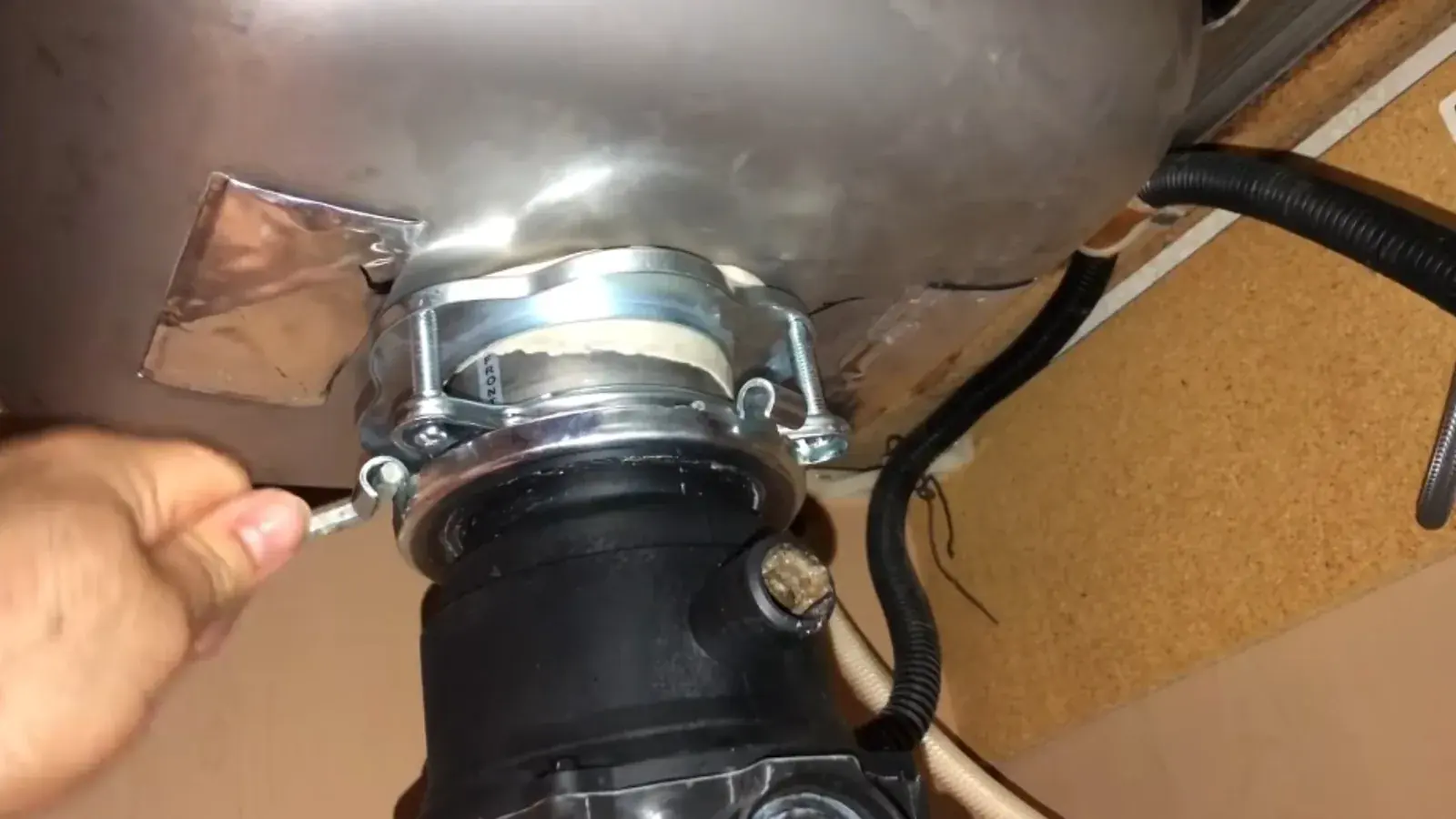
On a double sink with a disposal, the disposal sits under one basin and the second basin drains through a tailpiece that joins the disposal's outlet at a continuous waste tee. From there, one trap and one drain line serve both sinks and the dishwasher.
The common mistakes are a trap that is too low, a drain line that does not slope, and a dishwasher hose that is not looped high enough. Each causes slow drains and water rising in the other basin.
The parts, in order
| Part | Job | What goes wrong |
|---|---|---|
| Sink flange and disposal mount | Holds the disposal to basin one | Leaks at the flange seal |
| Disposal | Grinds food and discharges to the waste tee | Jams, leaks or hums |
| Second basin tailpiece | Carries water from basin two | Loose or kinked connection |
| Continuous waste tee | Joins both basins into one line | Clogs if the angle is wrong |
| P-trap | Holds a water seal against sewer gas | Leaks at slip nuts, clogs with grease |
| Dishwasher drain hose | Connects to the disposal inlet or tee | Kinked or too low, backs up |
Key layout rules
What a correct install looks like
- Knock out the dishwasher plug
If a dishwasher is connected, remove the knockout plug inside the disposal inlet before connecting the hose.
- Set the trap height
The trap should sit as high as the sink allows, with the line sloping down toward the wall.
- Loop the dishwasher hose
The hose should rise high under the counter before dropping to the disposal or tee, to prevent backflow.
- Join the basins correctly
Both drain arms enter the waste tee at the right height and are tight.
- Test with water
Fill both basins and release them at once to check for leaks and slow drainage.
Why water rises in the other basin
A slow drain with water rising in the second basin points to a partial blockage past the waste tee. Grease, coffee grounds and fibrous scraps collect in the trap and the first stretch of drain arm. A short cable run through the trap arm usually clears it. See drain cleaning for the process.
If the dishwasher also backs up into the disposal, check the hose loop and the knockout plug first. A missing knockout leaves the disposal chamber disconnected from the dishwasher, while an unremoved one blocks the flow.
Adding a disposal to an existing double sink
The sink needs a standard 3.5 inch opening in the basin, an outlet or a hard-wired switch, and room under the sink. The plumber will usually replace the old strainer, swap the trap arm and connect the dishwasher drain. If you are tying into old lines, the plumber also checks the drain slope and the vent. See garbage disposal repair and installation.
Common mistakes that cause slow drains
Problems we find under double sinks
- A trap that sits too low, so grease and scraps settle in it
- Long horizontal drain runs with no slope
- Two separate traps joined together, which can cause siphoning
- A dishwasher hose without a high loop
- Over-tightened slip nuts that crack or leak later
The high loop and the air gap
A dishwasher drain hose must rise to the underside of the countertop before it heads down to the disposal or trap. This high loop keeps dirty sink water from running backward into the dishwasher. Some installations use an air gap fitting on the countertop instead, and some local codes require one.
If you are not sure what your local code requires, ask the plumber or the health district before you buy parts.
Disposal power and noise
Three-quarter horsepower disposals are quiet enough for most homes. Heavier use or tougher scraps call for a larger motor, and added sound insulation helps in an open kitchen. A continuous-feed model is the usual choice, with a wall switch placed where children cannot reach it.
Planning the work: what to buy and what to ask
You will need a disposal, a mounting kit, a power cord or hard-wiring supplies, a continuous waste tee and tailpiece, and a trap. Many disposals come with the mounting parts, but the drain pieces vary. A plumber brings what fits the sink, so tell them the sink brand and depth.
Ask whether the quote includes a new trap and supply shutoff valves. Both are cheap at this point and awkward to replace later, since the cabinet is already open.
Kitchen drains in Fairborn homes
Greene County Public Health issues plumbing installation permits countywide and requires registration for anyone who installs plumbing, while its regulations exempt leaks and repairs in existing plumbing from the up-front permit. Adding a disposal is a new installation, so ask the health district whether your project needs a permit, and a registered installer, before you start.
Many Fairborn kitchens date from the mid-century building years and have original drain lines behind the wall. A new disposal does not fix a rough, scaled line behind it, so tell the plumber if your kitchen drain has been slow for years.
We serve Beavercreek and Riverside kitchens on the same 24/7 line.
Either. Many connect to a port on the disposal. Others tie to the tailpiece above the trap. Both need a high loop in the hose.
Yes. A continuous waste tee joins them above a single trap.
Usually a partial blockage or a missing vent. A cable run through the trap and drain arm often fixes it.
Many installations use a high loop instead. Code requirements vary, so ask the plumber or Greene County Public Health.
Three-quarter horsepower covers most households. Larger households may prefer one horsepower.