
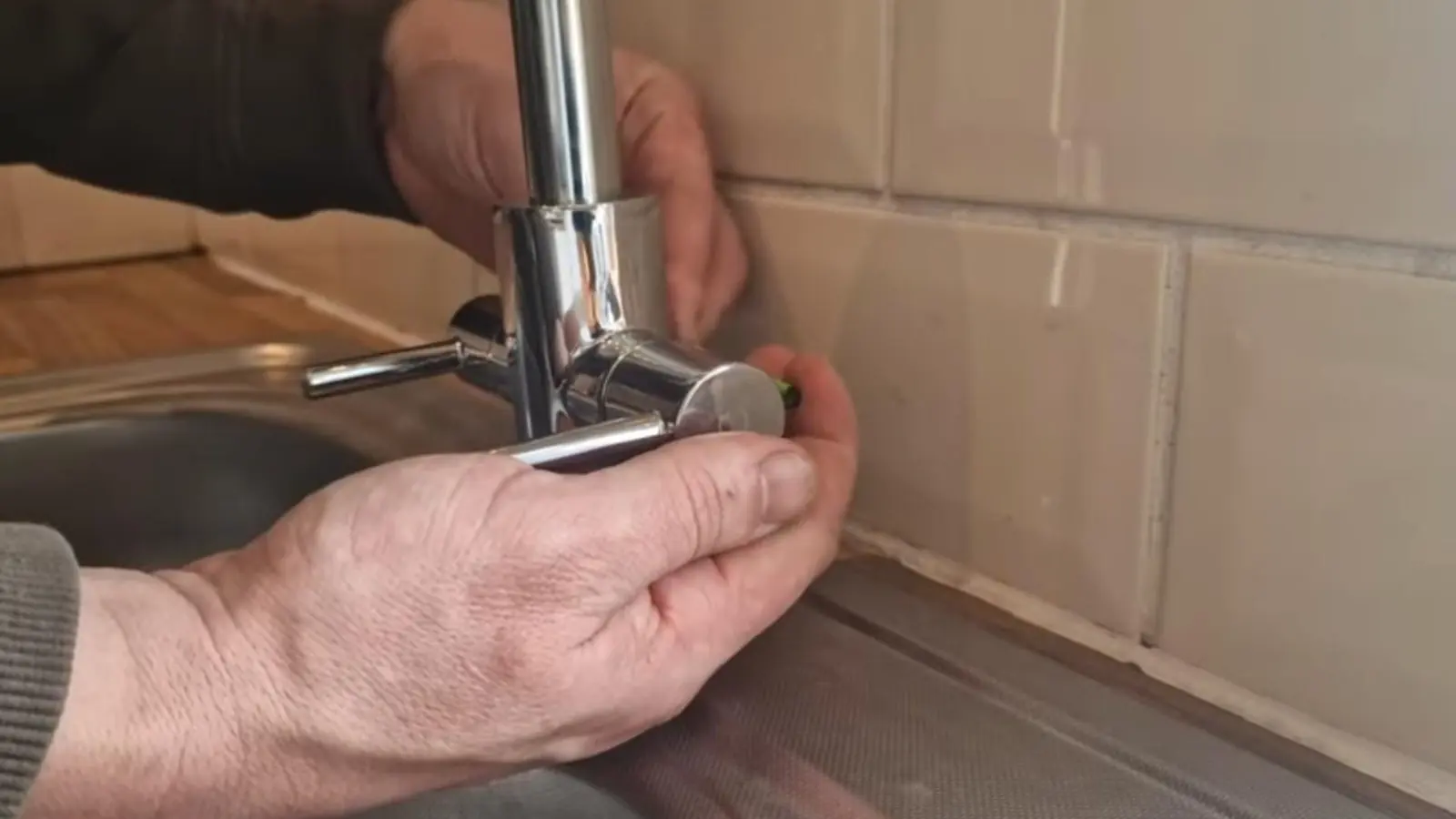
A kitchen faucet that drips, sprays sideways or runs weak almost always has a single failed part. Dripping from the spout points to a worn cartridge or washer. A weak stream usually means a clogged aerator. Water under the sink points to a loose supply line or a leaking base seal.
Most of these fixes take under an hour and a few basic tools. If the faucet is more than fifteen years old, the finish is worn or parts are hard to find, replacing it often makes more sense than repairing it.
Find the symptom first
| Symptom | Likely cause | Fix |
|---|---|---|
| Drip from the spout | Worn cartridge, washer or valve seat | Replace the cartridge or washer and seat |
| Weak or uneven stream | Clogged aerator or sediment in the cartridge | Unscrew and clean the aerator |
| Leak around the handle | Worn O-ring or loose cap | Replace the O-ring, tighten the cap |
| Water pooling under the sink | Failed supply line or base gasket | Replace the line or gasket |
| Sprayer hose leaks or sticks | Cracked hose or weak diverter | Replace the hose or diverter |
| Handle is loose or stiff | Worn set screw or mineral build-up | Tighten or clean the handle and stem |
Before you start: shut off the water
Safe setup for any faucet repair
- Close the shutoff valves
Turn the two small oval handles under the sink clockwise. If they will not move or drip, close the main valve instead.
- Open the faucet
Let the line drain and release pressure before you take anything apart.
- Plug the drain
A rag in the drain stops a small screw from vanishing into the trap.
- Take photos as you go
Pictures of each layer make reassembly much easier.
Fixing a dripping faucet
Pop the decorative cap on the handle, remove the screw and lift the handle off. A single-handle faucet has a cartridge under a retaining nut. Pull it straight out, note its orientation and bring it to a hardware store to match the replacement.
Older two-handle faucets use rubber washers and brass seats. A worn washer is a few cents, but a pitted seat will keep dripping until it is resurfaced or replaced.
Fixing weak flow
Unscrew the aerator at the tip of the spout and look at the screen. Tiny white or brown grit on it is mineral scale or sediment from the supply. Soak it in white vinegar for an hour, rinse it and screw it back on.
If the stream is still weak, the cartridge may be clogged, or one of the supply lines under the sink may be kinked.
When to replace instead of repair
A faucet that has been repaired twice in two years is telling you something. So is a corroded base, a finish that flakes or a model that parts are no longer made for. A new faucet comes with a warranty and new supply lines, and the labor is similar to a major repair.
A professional install also means the shutoff valves get checked and replaced if they are stiff, which is where many future emergencies start.
Call a plumber if you see any of these
- The shutoff valves under the sink will not turn or leak when moved
- Water is coming from the wall or from behind the sink cabinet
- Corrosion has fused the handle or the faucet body
- The sink drain is also slow, since that is a separate problem
- You cannot find the cartridge model and the faucet is more than fifteen years old
Picking a replacement that fits your sink
Count the holes in your sink or countertop before you shop. One, three and four hole sinks take different faucets, and a deck plate can cover extra holes. Check the distance from the faucet to the back wall, since a tall pull-down spout can hit a window sill or cabinet.
Look at the supply connections too. Most faucets today use flexible braided lines with half-inch fittings, but older sinks may need adapters. A plumber will bring the right ones and swap stiff shutoff valves while the cabinet is open.
Fairborn water and your faucet
The City of Fairborn's water treatment plant on Sandhill Road is classified as a Class III public water system that mainly removes iron and manganese. The water is then chlorinated and fluoridated, according to the city's own description of the plant. Minerals that pass through can still leave crust on aerators and cartridges.
If you have clogged aerators more than once a year, clean the screen sooner rather than later. Greene County's plumbing regulations exempt repairs and leaks in existing plumbing from the up-front permit, so a faucet repair does not need one, but new plumbing does. Ask the health district if you are unsure.
Hard to tell whether the faucet or the valve is at fault? Read the faucet and fixture repair page, or call about leak detection if water seems to be going somewhere you cannot see. Homeowners in Beavercreek and Riverside use the same 24/7 line.
Yes, if the shutoff valves under the sink work. Turn both clockwise and open the faucet to drain. If the valves are stuck or leak, use the main valve.
Most last ten to fifteen years, depending on water quality and use. Hard or sediment-heavy water shortens it.
Usually only if the part is inexpensive and the faucet is otherwise sound. A budget faucet with a cracked body is cheaper to replace.
Minerals and fine sediment in the supply collect on the aerator screen. The city's water is treated mainly for iron and manganese, and it does not list a hardness figure in its report, so a vinegar soak every few months is a sensible habit.
When the shutoffs fail, when water is behind a wall or when two repairs have not fixed it.