
Test your tap first
Fairborn's city water comes from wells in the Mad River Well Field, which sits over a buried valley aquifer, and the city's treatment plant is described as mainly removing iron and manganese. The city's water quality report does not list a hardness figure, so we do not state one.
Use a home test kit, or ask the Division of Water and Sewer Maintenance for its latest water quality report. If you are on a private well, send a sample to a certified lab. Then size the system to the real numbers.
Signs of hard water or mineral build-up
- White crust on faucets, showerheads and kettles
- Spots on glasses after the dishwasher
- Soap that does not lather and leaves a film
- Reduced flow at faucets from scale in aerators
- Short life or noisy operation of a water heater
| Water softener | Filter | |
|---|---|---|
| What it targets | Calcium and magnesium (hardness) | Sediment, chlorine taste, certain contaminants |
| How it works | Ion exchange resin, salt-based regeneration | Media or membrane, no salt |
| Upkeep | Salt refills and resin care | Cartridge or media changes |
| Where it goes | At the main line, before the water heater | At the main or at one tap |
What a water treatment installation involves
From test to working system
- Test and size
A hardness test and your household's water use decide the unit size.
- Place the unit
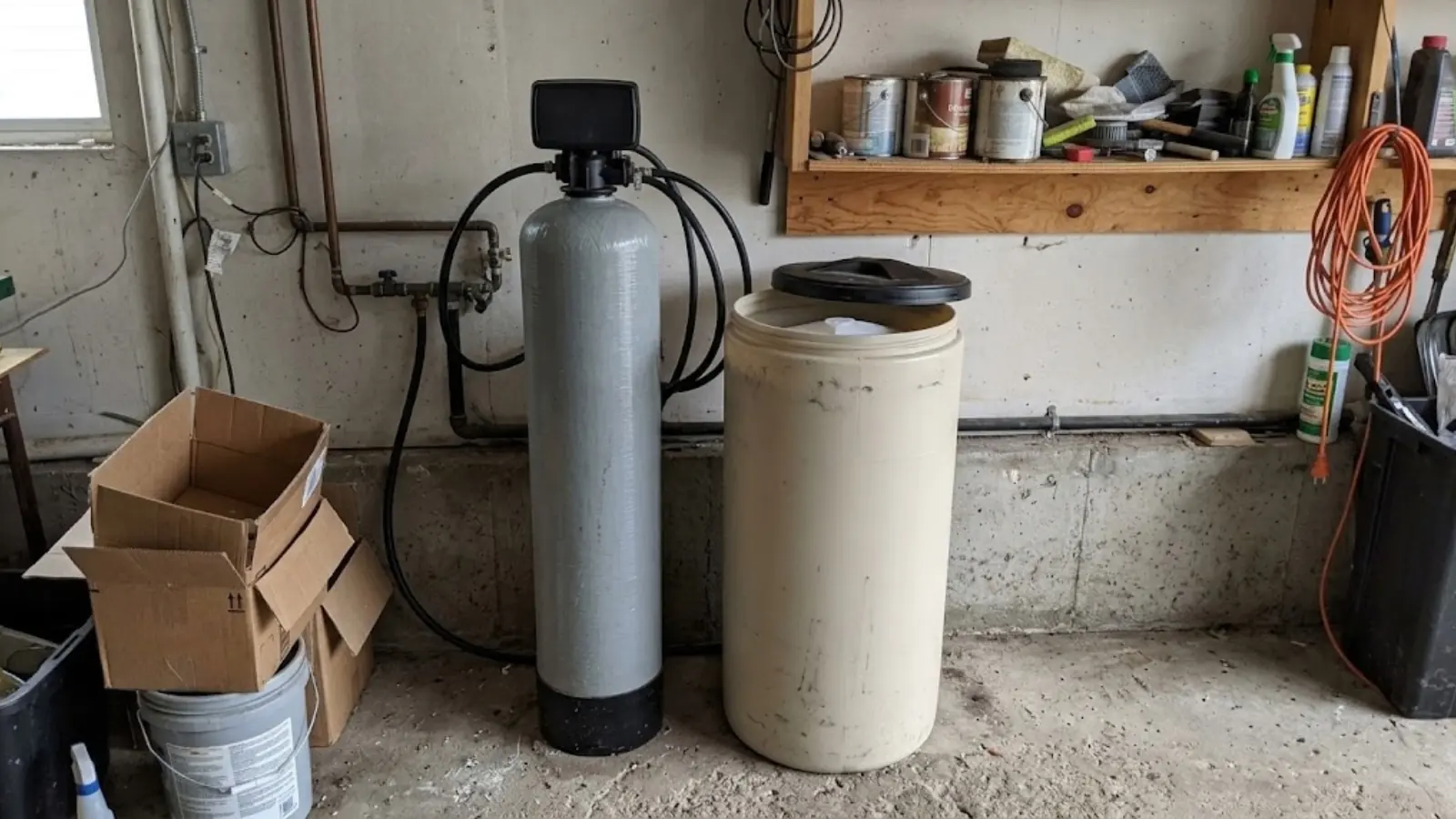
The softener goes near the main line with a bypass valve and a drain for regeneration.
- Connect plumbing and power
New supply connections, an overflow and a drain are installed, and the unit is plugged in.
- Program and test
The plumber sets the hardness, tests the water and shows you how to add salt.
Where the problem is mostly water heater scale, see water heater repair and the yearly flush advice there. A softener also helps faucets and fixtures last, see faucet repair.
Limits and honesty
We do not make health claims about drinking water. If you worry about lead or other contaminants, read the city's water quality report and talk to your doctor or the Greene County health district. A plumber can fit a filter once you know what you are treating.
Salt, regeneration and iron
A salt-based softener swaps calcium and magnesium for sodium. When the resin is full, it regenerates with a salt brine and flushes the minerals to the drain. You add salt every month or two, depending on use.
Softeners can remove small amounts of dissolved iron, but heavy iron can foul the resin. If your tap water stains fixtures orange or brown, a separate iron filter may be needed first. A water test tells the plumber which one fits.
Work like this is judged against the Ohio Plumbing Code, the standard inspectors apply. Greene County Public Health handles plumbing permits and inspections in the county, so ask your plumber who pulls the permit and what the inspection covers before the work starts.
Water facts for Fairborn
The City of Fairborn reported lead sampling results from 2023 of 2.7 parts per billion. The report adds that lead in tap water typically comes from service lines and household plumbing, not from the wells. If your house has older pipes, ask the plumber what material your service line and interior lines are.
Greene County Public Health handles plumbing permits and inspections, and permit rules vary, so ask whether a softener installation needs one.
What changes the price of a softener or filter
A softener is a planned purchase, not an insurance claim. Call for your real number.
The city's report does not publish a hardness number, so test your tap at home or ask the Division of Water and Sewer Maintenance for the latest report.
Only if your test shows hardness that causes problems. Scale on fixtures and a short-lived water heater are common signs.
Yes. Soft water leaves less scale on elements and the tank bottom.
Some can at low levels, but heavy iron needs a dedicated filter. A water test tells you which.