
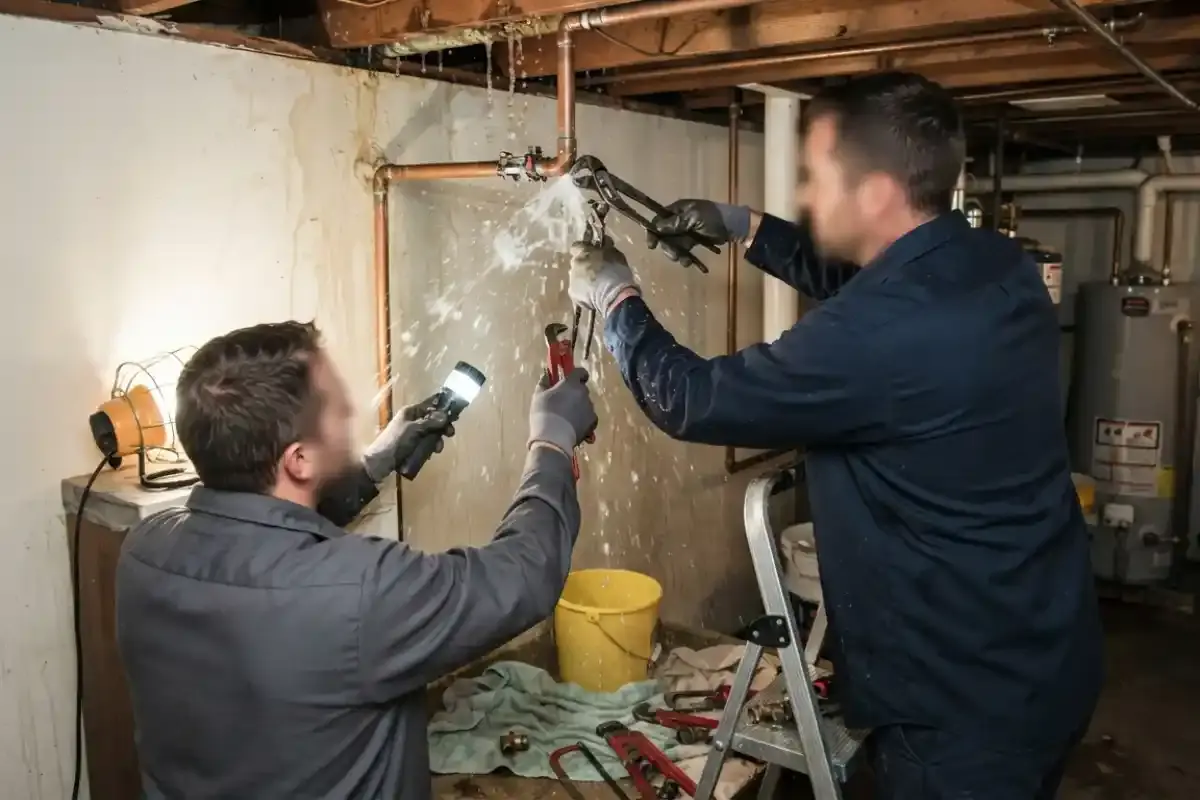
Turn off the main water valve at once. It usually sits where the supply line enters the house, near the meter. Turn it clockwise until it stops. Then open a faucet on the lowest floor to drain the lines and switch off breakers for any wet area, from a dry spot.
Once the water is off, photograph the damage for your insurance, move belongings out of the way and call a plumber. Do not wait for the water to dry before calling, since the pipe still needs repairing.
How repairs differ by material
| Material | Common break | Repair |
|---|---|---|
| Copper | Pinhole or a split from freezing | Cut out and splice with new copper or a coupling |
| PEX | Split from freezing or a fitting leak | Cut out and replace with a crimp or expansion fitting |
| Galvanized steel | Corroded section or a leaking thread | Replace a section, or consider a repipe |
| CPVC | Brittle crack | Cut out and replace with new CPVC or a transition |
| Cast iron drain | Crack or a failed joint | Replace a section with new pipe and couplings |
Why pipes break
Common causes of a broken pipe
- Water freezing in an exterior wall, crawlspace or unheated corner
- Corrosion in old galvanized or copper lines
- High water pressure with no regulator or a failed one
- Movement from settling soil or an unsupported run
- A previous repair that was not done properly
A temporary fix until the plumber arrives
A pipe repair clamp, a rubber patch with a hose clamp, or self-fusing tape can slow a small leak for an hour or two. They are not repairs. Use them to buy time, then have the section cut out and replaced.
If water is spraying from a pipe under pressure, do not try to patch it. Close the main and wait.
Preventing the next break
Insulate pipes in unheated spaces and keep cabinet doors open on cold nights. Know where the main shutoff is and exercise it twice a year so it does not seize. If the water pressure is over about eighty psi, a pressure reducing valve protects the plumbing. If breaks keep happening, read about repiping and ask for a pressure check.
A break in a wall, ceiling or crawlspace
Water inside a wall or above a ceiling spreads along framing and shows up far from the break. A bubble in the drywall or a stain on the ceiling is usually below the leak, not at it. Shut off the water first, then call so the plumber can trace it before any wall is opened.
In a crawlspace, look for dripping, wet insulation and white mineral stains on pipes. Take photographs before anything is moved.
What to record for your insurance
- Photos and video of the broken pipe and the water damage
- The time you found it and when you shut the water off
- A list of damaged belongings, with model numbers if you have them
- The plumber's written description of the cause and the repair
- Receipts for any cleanup or temporary lodging
What a permanent repair looks like
A permanent repair cuts out the damaged section and joins new pipe with fittings suited to the material. The system is then pressure tested and checked for leaks. If the cause was freezing, the plumber also looks at insulation and heat, so it does not freeze again.
Ask the plumber to show you the failed section. If it is badly corroded, ask whether other parts of the line look the same.
Should you repair the pipe yourself?
A homeowner can often fit a push-to-connect coupling on a small copper, PEX or CPVC break, if the pipe is dry and accessible. These couplings slide on without soldering or glue, and they are a legitimate repair when installed correctly.
The risk is in doing it badly. A coupling on pitted or out-of-round pipe may leak later inside a wall. For a leak in a wall, under a slab or on a galvanized line, call a plumber. Check Greene County's rules if you are unsure whether a permit or a registered installer is needed.
Pipe breaks in Fairborn houses
Fairborn grew about sixfold between 1950 and 1970, and the 2020 census counted 16,707 housing units in the city. Houses from those years commonly have copper or galvanized supply pipes that are now decades old, which is why pinholes and corroded sections turn up in our calls. Cold snaps hit unheated crawlspaces and exterior walls first.
Plumbing work in Greene County is overseen by Greene County Public Health, whose regulations exempt leaks and repairs in existing plumbing from the up-front permit. For commercial work, contractors must show a current state license. The Ohio Construction Industry Licensing Board has an online company lookup you can use to verify any contractor.
Read the emergency burst pipe repair page for what the visit involves. Our 24/7 line also covers Xenia and Beavercreek.
Usually in the basement or utility room where the line enters the house, near the meter. Find and test it before you need it.
Many policies cover sudden bursts and resulting damage, but not slow leaks or wear. Take photos and read your policy.
Often yes. Leak detection narrows the spot, and the plumber opens a small access hole.
Water freezes in pipes in unheated spaces and splits them. Insulation and heat on cold nights are the cheapest protection.
For commercial contractors, use the Ohio Construction Industry Licensing Board's lookup. In Greene County, plumbers also register with the health district each year.