
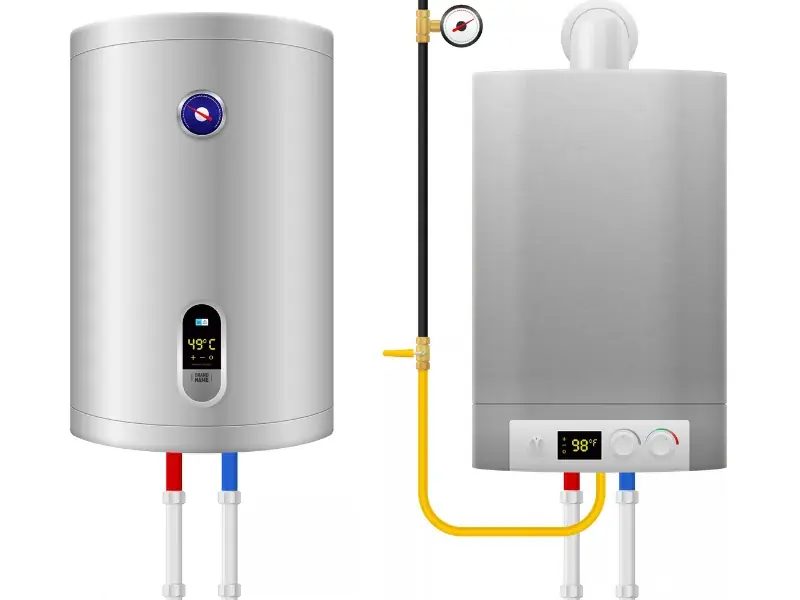
A tankless heater replaces a stored tank with a unit that heats water on demand. You never run out in one shower, and the unit uses wall space instead of floor space. The trade-off is a higher upfront cost and often a bigger gas line, a different vent and regular descaling.
For many homeowners, the question is not whether tankless is good, but whether their house can support it affordably. The answer starts with the gas line.
What changes in the house
| Item | Like-for-like tank | Tankless |
|---|---|---|
| Gas line | Existing line usually works | Often needs a larger line or meter check |
| Venting | Existing flue may work | New sealed vent through a wall or roof |
| Electrical | Usually none for gas | Outlet for controls, or heavy service if electric |
| Water piping | Reuse existing | Isolation valves and maybe a recirculation line |
| Drain | Relief valve discharge only | Condensate drain for condensing models |
| Footprint | Floor space | Wall space |
Does it save money?
Tankless units avoid the standby heat loss of a stored tank, so they use less fuel for the same hot water. Whether that covers the higher install cost depends on how much hot water you use, how much the swap requires and the fuel prices you pay. For a small household with a low-cost tank swap, the payback can be long. For a large household with an old tank and an easy install, it is shorter.
A plumber can compare the numbers using your own house details.
The gas line question
A tank heater burns a modest amount of gas. A whole-house tankless can need several times that rate, which can exceed what a small gas line and meter can deliver. The plumber measures the length and size of the line and the total gas load of the house, then decides if the line must be upsized.
This is the step that turns a straightforward swap into a larger project, and it is why a phone price without a visit can be misleading.
Descaling and maintenance
Minerals build up in the heat exchanger and reduce performance. Yearly flushing with a descaling solution is a common routine, and isolation valves make it quick. Without it, error codes and weak flow appear within a few years.
Sizing a tankless heater: flow and temperature rise
A tankless heater is sized by two numbers. The first is flow, measured in gallons per minute, which is how many fixtures run together. The second is temperature rise, which is the difference between the incoming water temperature and the temperature you want. Colder incoming water in winter means a bigger rise and a lower flow rate from the same unit.
A plumber adds up your fixtures and uses a winter incoming temperature to choose the unit, so you do not run short in January.
| Fixture | Approximate flow |
|---|---|
| Bathroom sink | About 1 gallon per minute |
| Kitchen sink | About 1.5 to 2 gallons per minute |
| Shower | About 2 to 2.5 gallons per minute |
| Dishwasher | About 1.5 gallons per minute |
| Washing machine | About 2 gallons per minute |
Recirculation and waiting for hot water
A tankless heater does not eliminate the wait for hot water to reach a faraway tap, because the pipe between the heater and the fixture is still full of cold water. A recirculation line, or a small buffer tank, shortens the wait. It adds cost but can save water, so it is worth asking about if a bathroom is far from the heater.
Venting and condensate
Condensing tankless units are very efficient, so their exhaust is cool enough to use plastic vent pipe, but they produce acidic condensate that must be drained and neutralized. The plumber plans a drain and a neutralizer cartridge, which are part of a correct installation.
Who benefits most from a tankless swap
Households that run out of hot water with a tank, homes short on floor space and people who plan to stay in the house for many years are the usual winners. Owners of a small house with one or two people who use little hot water get less back from the extra investment.
If you are unsure, ask the plumber to look at your gas bill and your hot water habits. The honest answer may be to replace the tank with another tank and keep the money.
Tankless in older Fairborn homes
Fairborn's treatment plant is described by the city as mainly removing iron and manganese from the Mad River Well Field water, then chlorinating and fluoridating it. Those minerals are the reason to plan for yearly flushing on any heater. Hardness is not listed in the report, so a home test is a good first step.
Greene County Public Health lists water heaters among the systems its inspectors cover and handles plumbing permits countywide. A gas tankless swap may need a permit and an inspection, so ask before you buy.
Compare options on the tankless page and water heater replacement page. We serve Riverside and Kettering too.
More upfront, and the gap depends on the gas line and vent work. A quote after a visit gives the real figure.
Within the unit's flow limit. Running several showers and a dishwasher at once can exceed it.
Usually not. Tankless units need a vent rated for their exhaust temperature and type.
Test your tap, or ask the city's water division for its latest report. Flushing the unit yearly is a good rule either way.
Most tankless heaters need power for the controls, so they will not heat without it.