
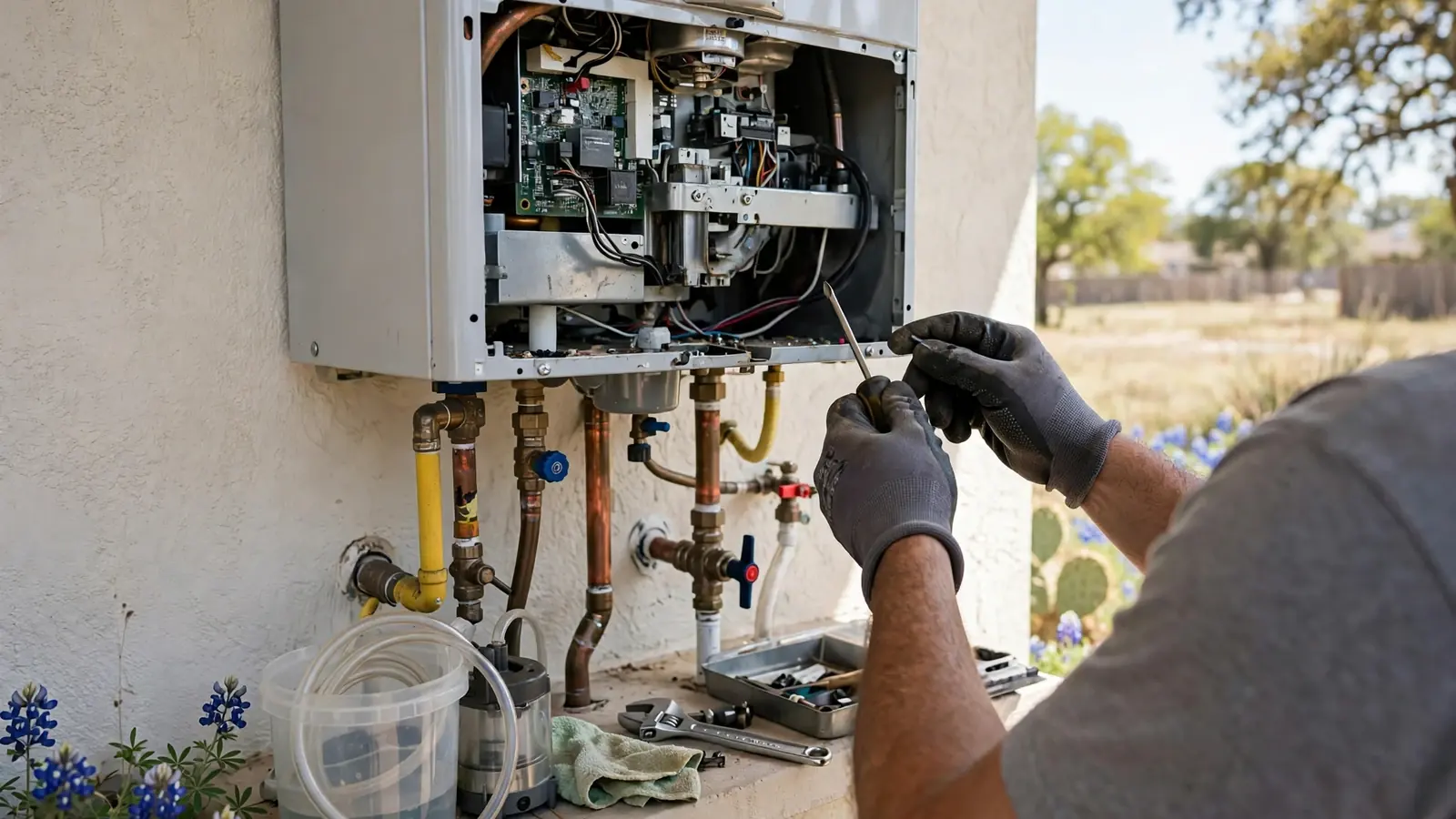
Tankless versus a tank: the honest comparison
| Question | Tank water heater | Tankless water heater |
|---|---|---|
| How hot water is produced | Stored in a tank and kept hot | Heated on demand as water flows |
| Run out of hot water? | Yes, when the tank is used up | Not within the unit's flow limit |
| Space | Needs floor space | Wall mounted, small footprint |
| Typical life | About 10 to 15 years | Often longer, with regular descaling |
| Upfront cost | Lower | Higher, including any gas or vent upgrades |
| Maintenance | Flush yearly | Descale on a schedule set by water quality |
Tankless is a good fit for a household that runs out of hot water or wants floor space back. It is a poor fit if the gas line is too small and the cost to upgrade it outweighs the benefit. See water heater replacement for the tank route.
What a tankless installation needs
Checks before the unit is ordered
- Gas line size and meter capacity for the higher burner input
- A correct sealed vent path through a wall or roof, with proper clearances
- A condensate drain for high-efficiency models
- Electrical outlet and surge protection for the controls
- Cold and hot water piping sized for the flow you want
Flushing and descaling a tankless heater
Minerals in the water coat the heat exchanger over time. The unit works harder, hot water gets weaker, and error codes start to appear. A flush with a descaling solution cleans the exchanger and the pipes around it.
How often depends on your water. Fairborn's municipal water comes from wells in the Mad River Well Field and the city's treatment is aimed at iron and manganese, so mineral content is a fair concern. A yearly flush is a sensible start, and a home hardness test can adjust that.
Tankless repair: common faults
| Symptom | Likely cause | Fix |
|---|---|---|
| Error code and no hot water | Blocked vent, low gas, or scaled exchanger | Clear the fault and descale |
| Lukewarm water | Flow too low or exchanger scaled | Clean the inlet filter and flush |
| Water turns cold then hot | Cold water sandwich from short run times | Adjust settings, consider a recirculation line |
| Unit will not ignite | Low gas pressure or failed igniter | Test the gas supply and replace the igniter |
Work like this is judged against the Ohio Plumbing Code, the standard inspectors apply. Greene County Public Health handles plumbing permits and inspections in the county, so ask your plumber who pulls the permit and what the inspection covers before the work starts.
Fairborn gas and homes
Houses built during Fairborn's 1950 to 1970 growth years were typically plumbed with a gas or electric tank heater in mind. A tankless unit can need several times the burner input of a tank, so the gas line and meter are the first things to check.
If you want to check any plumber doing gas work, the Ohio Construction Industry Licensing Board has an online lookup, and Greene County Public Health handles plumbing permits and inspections for the county. Ask which apply to your project.
What changes the price of a tankless job
Tankless units are usually planned purchases and not an insurance claim. Ask the plumber about the manufacturer warranty before you decide.
It depends on your gas or electric service and your hot water habits. The plumber checks your supply and compares it against your current tank before you commit.
At least yearly is a common starting point, and sooner if your water is hard. A home test strip tells you where you stand.
We service the common residential brands. Tell the dispatcher the brand and the error code and they will confirm before booking.
It is urgent, and the 24/7 line is open. A no-heat call can often be sorted by clearing a fault code or a blocked filter.