
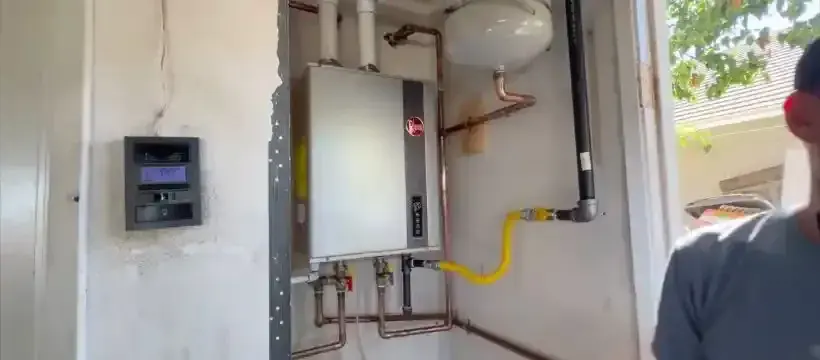
What a water heater installation involves
Installation covers more than setting a tank on the floor. The plumber sizes the unit to your household, checks that the room has the clearance and combustion air it needs, and makes sure the gas line, electrical circuit or condensate drain suits the new heater.
This is why two homes with the same size tank can have very different installation costs. The difference is usually in the venting and the supply lines, not the tank itself.
| Type | Strengths | Needs |
|---|---|---|
| Gas tank | Fast recovery, lower running cost where gas is available | Proper flue and combustion air |
| Electric tank | No vent needed, simple to install | A dedicated circuit of the right size |
| Tankless gas | Endless hot water, small footprint | A larger gas line and a special vent |
| Tankless electric | Compact, no vent | Very high electrical capacity |
| Heat pump tank | Much lower electricity use | Open space, airflow and a condensate drain |
Sizing: gallons are not the whole story
A heater is sized by its first-hour rating, which is how much hot water it can deliver in the first hour of use. Count the fixtures that run at the same time, such as a shower and a dishwasher, and match that to the unit.
An undersized heater runs out during a long shower. An oversized one costs more to buy and to heat. The plumber walks through your actual habits instead of picking a default.
Code, permits and safety parts
What the installer adds beyond the tank
- Relief valve and discharge pipe
A temperature and pressure relief valve is required, with a pipe that runs to a safe drain point.
- Expansion tank
Closed plumbing systems often need one to absorb thermal expansion and protect the valve and fixtures.
- Drain pan
A pan with a drain line limits damage when a future leak happens.
- Shutoff valves and unions
New valves and unions make a later repair faster and cheaper.
- Venting and gas connection
Gas units get a correctly sloped vent, a sediment trap and a leak-tested gas connection.
Permit and inspection rules vary by job, so ask Greene County Public Health or the city whether yours needs one. A plumber who works here regularly will know. After the install, the water heater repair page explains routine care such as flushing and the anode rod.
Placement in Fairborn homes
Safety around a new water heater
- If you smell gas, leave the house and call the gas utility or 911 first
- Never block the vent, and keep paper, paint and fuel away from the unit
- Check that the temperature and pressure relief valve has a discharge pipe
- Keep the water heater area clear, and test the carbon monoxide alarm on the floor above
The Ohio Plumbing Code is the standard inspectors apply to this kind of work. Greene County Public Health handles plumbing permits and inspections in the county, so ask your plumber who pulls the permit and what the inspection covers.
Homes in a newer community such as Waterford Landing may still have a builder or manufacturer warranty on the heater, so check the paperwork before you choose who installs the replacement.
Basements, closets and additions
Fairborn has a mix of mid-century houses, older homes in the Osborn area and newer construction. Older homes often have the heater in a basement corner or a utility closet, and the flue may share a chimney with a furnace. A new high-efficiency unit may need a different vent path.
Homes with finished basements or additions often have no existing heater location at all. In that case, plan for the drain, the vent and a spot where leaks will not reach finished floors.
What changes the price of an installation
Installations are planned work, so they are not usually an insurance claim. Ask about manufacturer warranty terms, which often require professional installation.
Same-day appointments are offered when available, but planning a few days out gives you time to pick the type and confirm venting. If your heater has already failed, call the 24/7 line instead.
Often yes, but it costs more than a swap. Water, gas or electrical lines, the vent and the drain all have to reach the new location.
Many closed systems do, including those with a pressure reducing valve or backflow device. The plumber checks your house pressure and the system at the quote.
Yes. Gas units must vent combustion gases outdoors through a correctly sized and sloped flue, and sharing a chimney needs a liner check.
Yes. New spaces need a heater location, a drain point and the right vent or circuit. The plumber confirms these at the quote.