
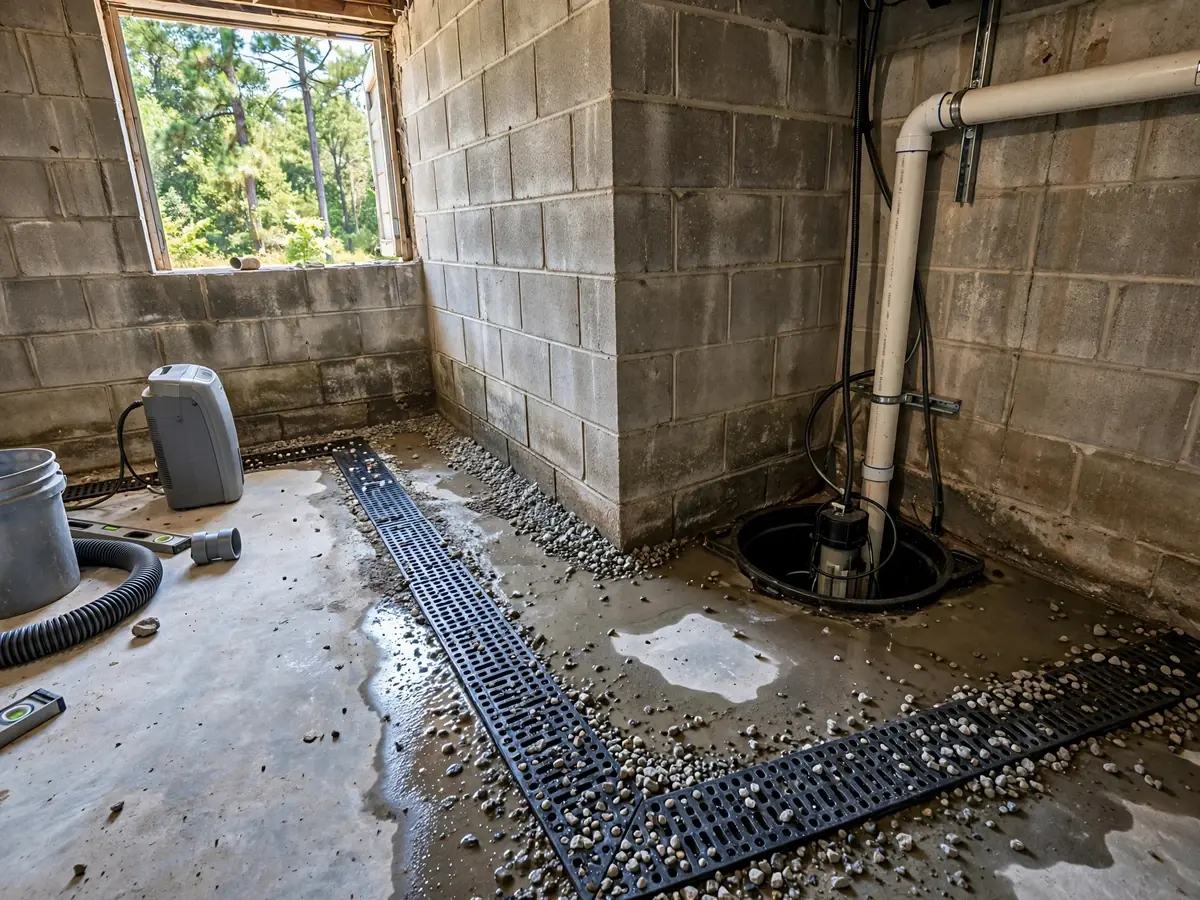
DIY basement waterproofing works when the water comes from the surface: gutters that overflow, downspouts that drop water next to the foundation, soil that slopes toward the house. It does not work against groundwater pushing up through the floor or in through the wall, which needs drainage and a pump.
The cheapest rule is to fix everything outside first. If water still appears after that, you have a drainage problem and a coating will not solve it.
Start outside: the free and cheap fixes
Do these before buying any sealer
- Clean the gutters and fix leaking joints
- Extend downspouts at least six feet from the foundation
- Re-slope soil so it falls away from the house for the first several feet
- Fill low spots near the foundation with compacted clay-rich soil
- Cover window wells and make sure they drain
What each DIY product can and cannot do
| Product | Can help with | Will not fix |
|---|---|---|
| Masonry waterproofing paint | Light dampness on a dry wall | Water pushing through, standing water |
| Hydraulic cement | Small static cracks and holes | Cracks that move or leak under pressure |
| Dehumidifier | High humidity and musty smell | Active water entry |
| Window well covers and liners | Rain entering at window wells | Floor or wall seepage |
| Crack injection kit | A single narrow crack | Many cracks or a failing wall |
A simple test for moisture type
Tape a one-foot square of plastic sheeting tightly to a bare wall or floor and leave it for two days. Moisture on the room side of the plastic means condensation, which a dehumidifier solves. Moisture on the wall side means water is moving through the masonry, and drainage is the answer.
When drainage is the real answer
If water appears where the floor meets the wall, after heavy rain, or at several places, an interior drain system is the dependable fix. A channel is cut along the footing, perforated pipe goes in gravel, and the water runs to a sump pit that pumps it outside. It controls water without digging around the house.
See sump pump repair and installation for the pump half, and basement waterproofing for the system.
Mold is a separate job
We handle the water source. If you see black growth on drywall or wood after repeated wet spells, a qualified mold remediation company should assess it. Fixing the water first stops it from coming back.
Gutters, grading and downspouts done properly
Water that falls on the roof should leave the yard without ever touching the foundation. Gutters should be cleaned in spring and fall and pitched so water runs to the downspouts. Downspouts need extensions or buried pipe that carries water at least six feet from the wall.
Soil next to the house should fall about six inches over the first ten feet, where the lot allows. Add soil rather than mulch, since mulch holds water against the wall.
Sealing a small crack with hydraulic cement
A basic crack repair
- Chisel the crack open
Cut a shallow V-shaped groove so the cement has something to grip.
- Clean it out
Brush away dust and loose concrete, and wet the surface.
- Mix and pack
Mix a small batch to a putty and press it in firmly, holding for a minute.
- Let it cure and test
Check after the next heavy rain. If it leaks again, the crack is moving or water pressure is too high.
A crack that keeps reopening, a wall that bows, or water in several spots is outside what DIY can fix. Stop and ask for an inspection.
Interior sealing versus drainage: a quick decision guide
A coating or a sealer is a surface treatment. It works when the wall is dry and the problem is humidity or a tiny amount of seepage. A drainage system is a plumbing treatment. It works when water arrives in volume, because it gives the water a route that does not end on your floor.
If you can see water running, pooling or pushing the paint off in sheets, you are in drainage territory. A coating applied over a wet wall can trap moisture and make the damage worse, so pause before you buy.
Basements in Fairborn
Fairborn's well field sits beside the Mad River, and the city draws its water from a buried valley aquifer. We do not claim that any street floods. The city grew about sixfold between 1950 and 1970, and many homes from those years have block-wall basements, which absorb and pass water more than poured concrete.
Greene County Public Health issues plumbing permits countywide. A sump pump with a new discharge line or a drain connection is plumbing work, so ask the health district whether your project needs a permit and a registered installer.
Neighbors in Riverside and Kettering deal with the same kinds of older basements.
Only for light dampness on a dry wall. If water is pushing through, paint peels and the problem stays.
Almost always. The pipe needs somewhere to send the water.
It is efflorescence, minerals left when water moves through masonry and dries. It tells you water is passing through, even if the wall looks dry.
It is possible, but it means excavating around the house and is costly. Interior drainage is the more common approach.
If water appears only during or just after heavy rain and near the walls, surface water is likely. If it comes through the floor days later, groundwater is the cause.