
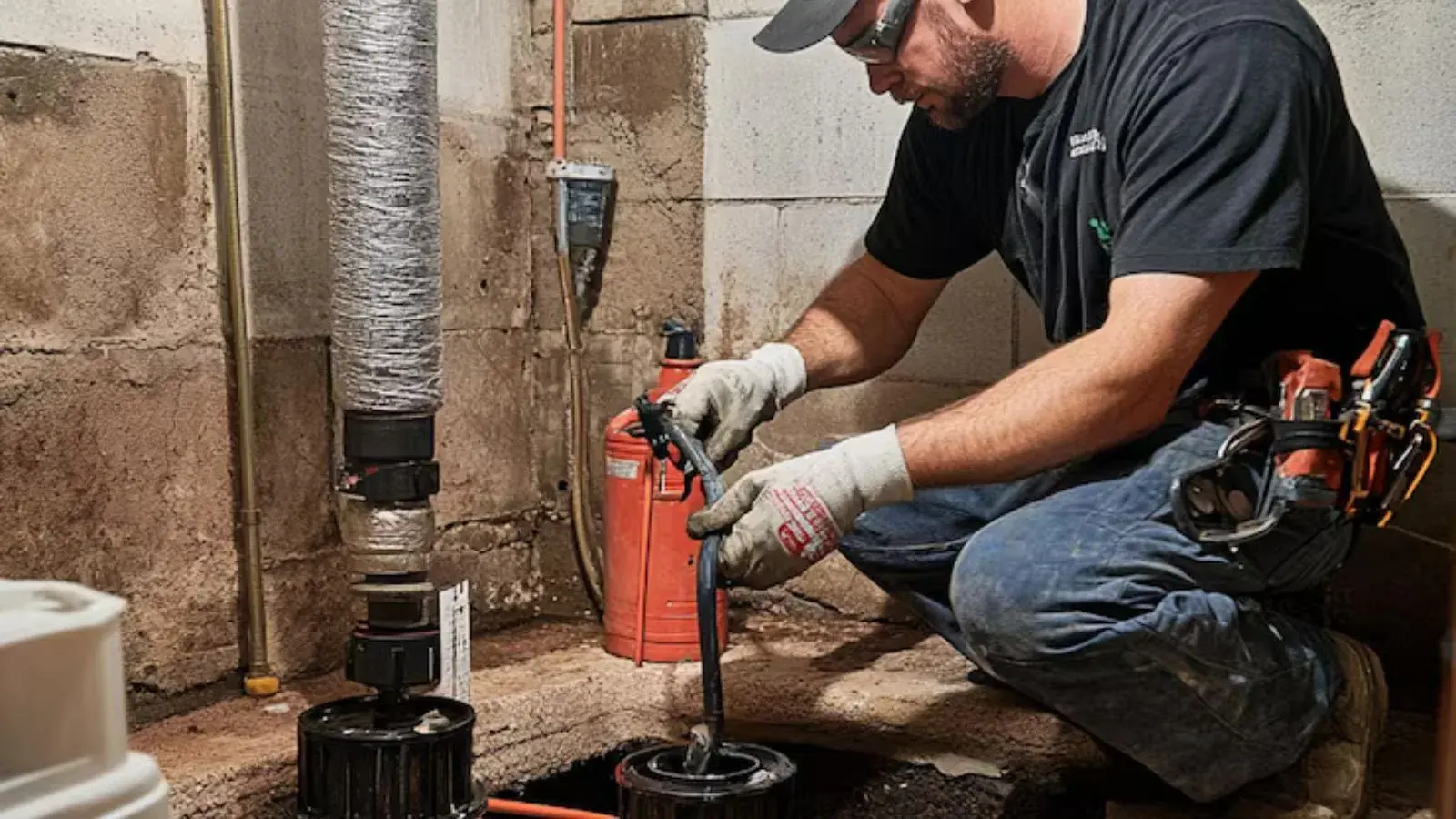
A sump pump sits in a pit in the lowest part of the basement. When water fills the pit, a float switch turns the pump on, and the pump pushes the water out through a pipe to the yard. A proper install has five parts: a pit, a pump, a check valve, a discharge pipe and a reliable power source.
Most homeowners with a working pit can swap a pump in an hour. Starting from nothing means breaking the floor, which is a bigger job and is usually left to a plumber.
The parts a complete sump system needs
| Part | What it does | What to check |
|---|---|---|
| Pit or basin | Collects water from drain tile or the floor | Sealed lid, clean, at least 18 inches deep |
| Pump | Pushes water out of the pit | Submersible or pedestal type, correct horsepower |
| Float switch | Starts and stops the pump | Moves freely, does not touch the wall |
| Check valve | Stops pumped water from draining back | On the discharge line, flow arrow pointing out |
| Discharge pipe | Carries water outside | Sloped, drains away from the foundation |
| Power | Runs the pump | Dedicated, grounded outlet with GFCI protection |
Step by step: replacing a pump in an existing pit
A typical swap
- Unplug the pump
Never work on a pump that is connected to power.
- Disconnect the discharge
Loosen the union or coupling above the check valve and lift the pump out.
- Clean the pit
Remove silt and gravel so the new float can move freely.
- Set the new pump
Place it on a flat base or a brick, with the float clear of the sides.
- Reconnect and test
Reattach the check valve and discharge, plug in and pour water in the pit to confirm it starts and stops.
Where the water goes
The discharge pipe should carry water well away from the foundation, at least ten feet where the yard allows, and must not run onto a neighbor's property. It should slope away from the house so it drains when the pump stops.
Do not connect it to the sanitary sewer. Most communities treat that as a violation, and it can overload the sewer in heavy rain. Ask your local building office what discharge is allowed.
Battery backup and alarms
A sump pump needs power at exactly the wrong moment, because storms cut it. A battery backup pump gives hours of protection. A high-water alarm costs little and warns you before the floor gets wet. Both are worth adding if the basement is finished.
When a plumber is the better choice
Cutting a new pit through a concrete slab, tying in drain tile, adding a sealed lid with a vent, and running a discharge through a wall all call for tools and experience. A mistake can leave you with a pit that does not drain or a lid that lets radon in. See the basement waterproofing page if water is entering at several places.
Sizing the pump to the job
Most homes do well with a one-third or one-half horsepower submersible pump. A bigger motor moves water faster but cycles on and off more, and it wastes power if the pit fills slowly. The better question is how high the water must be lifted and how far it travels.
A pump rated for the lift is more important than a bigger motor. The rating curve on the box shows how many gallons per hour it moves at a given height, and a plumber can read that against your discharge route.
Test your pump every spring
- Pour a bucket of water into the pit and confirm the pump starts
- Watch that the float rises and falls freely
- Listen for grinding, rattling or loud humming
- Check that the discharge pipe is clear and flowing outside
- Test the battery backup and replace the battery on schedule
Common installation mistakes
The most frequent errors are a float that rubs the pit wall, a discharge pipe without a check valve, a discharge that ends too close to the house, and a pump plugged into an outlet shared with other loads. Each one is easy to avoid and costly to find during a storm.
A pit lid that is not sealed can also let moisture and radon into the room. If you are unsure, a quick visit from a plumber is a cheap check on a system that guards the whole basement.
Fairborn notes for a sump install
Greene County Public Health issues plumbing installation permits countywide and requires registration for anyone who installs plumbing. The county's regulations also allow an owner who personally does the work on a single-family home they live in to receive a permit, even without being registered. Ask the health district whether a sump installation counts as plumbing under its rules.
The City of Fairborn's wells sit in the Mad River Well Field beside the river, over a buried valley aquifer. We do not claim that your street floods. A basement that stays damp after heavy rain is simply the reason to have a pit.
If you want a pump installed or replaced, read about sump pump repair and installation. We also serve Xenia and Beavercreek on the same line.
Yes. Without one, water in the discharge pipe falls back into the pit and the pump cycles on again and again.
Deep enough that the pump sits below the floor level and the float has room to move. Eighteen inches or more is common.
A homeowner can replace a pump in an existing pit. For new plumbing, check the county's rules first, since registration and permits may apply.
Water backs up in the pipe and the pump may burn out. Use a discharge with a slope and consider a freeze-resistant outlet.
It depends on the work. Greene County Public Health handles plumbing permits countywide, so ask them whether your installation is covered before you start.