
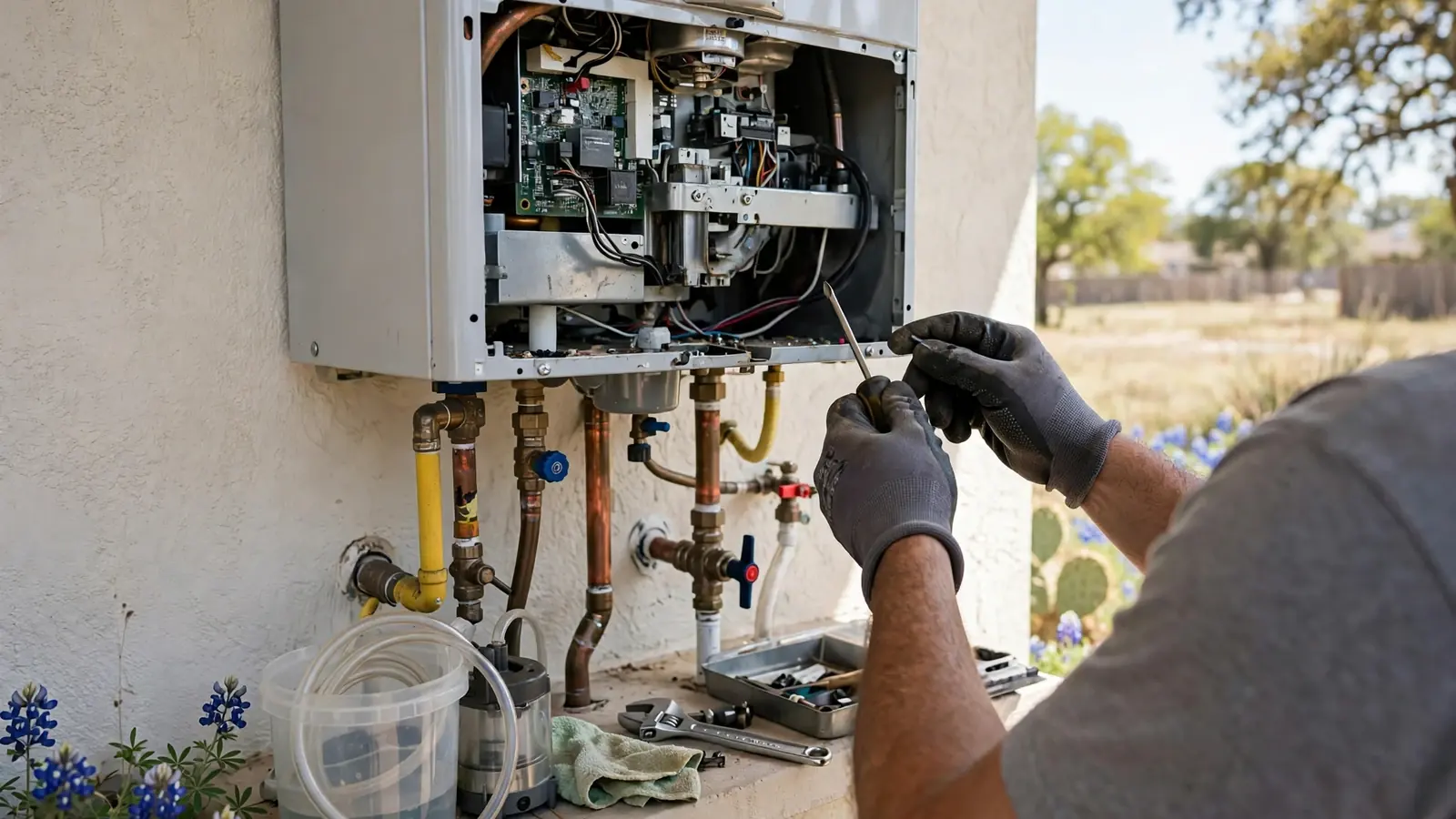
A tankless water heater heats water as it flows, so it does not expand a stored tank of water the way a tank heater does. Still, many tankless installations include an expansion tank, because the issue is not the heater. It is a closed plumbing system, where a backflow valve or pressure reducing valve stops expanding water from going back into the street main.
If your house has either device, thermal expansion from any heated water, including that in the pipes, has nowhere to go, and pressure can rise. An expansion tank absorbs it.
Closed system or open system?
| Your system | Expansion tank needed? | Why |
|---|---|---|
| Open system, no check valve at the meter | Usually not | Expanding water can flow back into the main |
| Pressure reducing valve on the main line | Often yes | The valve closes the system |
| Backflow preventer or check valve at the meter | Often yes | Water cannot return to the main |
| Recirculation line with a check valve | Often yes | A check valve closes the loop |
| Tank water heater on a closed system | Yes | The tank heats and expands water |
How to check your own pressure
A simple pressure test
- Buy a hose bib gauge
An inexpensive gauge screws onto an outdoor spigot or the washing machine valve.
- Turn off every fixture
Make sure no water is running in the house.
- Read the gauge
Normal house pressure is typically between forty and eighty psi.
- Watch it after a hot water cycle
If it climbs well above the base reading, thermal expansion may be an issue.
Sizing and placement
The tank is sized by the volume of water in the system and the house pressure. A typical residential unit is small and attaches to the cold supply line near the water heater with a tee. It should be supported, since a full tank is heavy, and it should sit upright where it can be reached.
Check it each year. Press on the air valve like a tire stem. If water comes out, the bladder has failed and the tank needs replacing.
Why a dripping relief valve matters
The temperature and pressure relief valve is the safety device on a water heater. If it drips after every heating cycle, the cause is often high pressure from thermal expansion. Replacing the valve alone will not help, because the pressure returns. See water heater repair for the checks the plumber makes.
Signs your expansion tank has failed
Check these once a year
- Tap the tank. A healthy one sounds hollow at the top and solid at the bottom
- Press the air valve. Water spraying out means the bladder failed
- The relief valve drips after every heating cycle
- House pressure spikes above eighty psi when the heater runs
- Faucets or toilets hammer or leak at high pressure
Thermal expansion, simply
Water takes up more space as it heats. In an open system, the extra volume pushes back into the main and nobody notices. In a closed system, the water has nowhere to go, and the pressure rises sharply. A small tank with a rubber diaphragm and an air cushion gives it a place to go.
Without it, the extra pressure lands on the heater, the relief valve and every fixture in the house. Over time, it shortens the life of all of them.
Pressure reducing valves
A pressure reducing valve near the main shutoff steps high street pressure down to a safe level for the house. It also closes the system, which is why homes with one often need an expansion tank. If your pressure reads over eighty psi, the valve is worth discussing with a plumber.
What an install looks like
The plumber shuts off the water, relieves pressure and adds a tee on the cold supply near the heater. The expansion tank screws onto the tee, and the plumber sets the tank's air charge to match your house pressure with a tire gauge before it is filled. A tank with the wrong charge cannot do its job.
Then the water is turned on, the tank fills, and the system is checked for leaks and for any pressure creep. The whole job often takes under an hour when the access is good.
Safety when working near the heater and tank
- Turn off the gas or the power to the heater before any work
- Close the cold supply and relieve pressure at a faucet before opening a fitting
- Let the unit cool, because hot water and parts can burn
- If you smell gas, leave the house and call the gas utility or 911
The Ohio Plumbing Code is the standard inspectors apply to this kind of work. Greene County Public Health handles plumbing permits and inspections in the county, so ask your plumber who pulls the permit and what the inspection covers.
Fairborn pressure and plumbing rules
The City of Fairborn's water treatment plant works with five water towers and pump or booster stations to maintain pressure, according to the city's description of its system. House pressure varies from street to street with elevation and distance, so measure yours before choosing a tank size or deciding on a pressure reducing valve.
Greene County Public Health lists water heaters among the systems its plumbing inspectors cover, and it adopts the Ohio Plumbing Code. Ask the health district what applies to a new water heater installation, and whether a permit is needed.
If you are switching systems, see tankless water heater service and water heater installation. Crews also cover Beavercreek and Xenia.
No. It depends on whether the plumbing is a closed system. A plumber can check for a pressure reducing valve or a backflow device.
On the cold water line close to the heater, supported from above or below.
Often five to ten years. Test the air valve yearly.
It is plumbing work, so check Greene County Public Health's rules on permits and registration first.
The city system's pressure can vary with elevation. A pressure reducing valve brings it down, and an expansion tank absorbs the resulting thermal expansion.